The James Webb Space Telescope: What It Has Taught Us About the Early Universe
Oct 8, 2026 · By Adnan Brohi · Science · 176 views
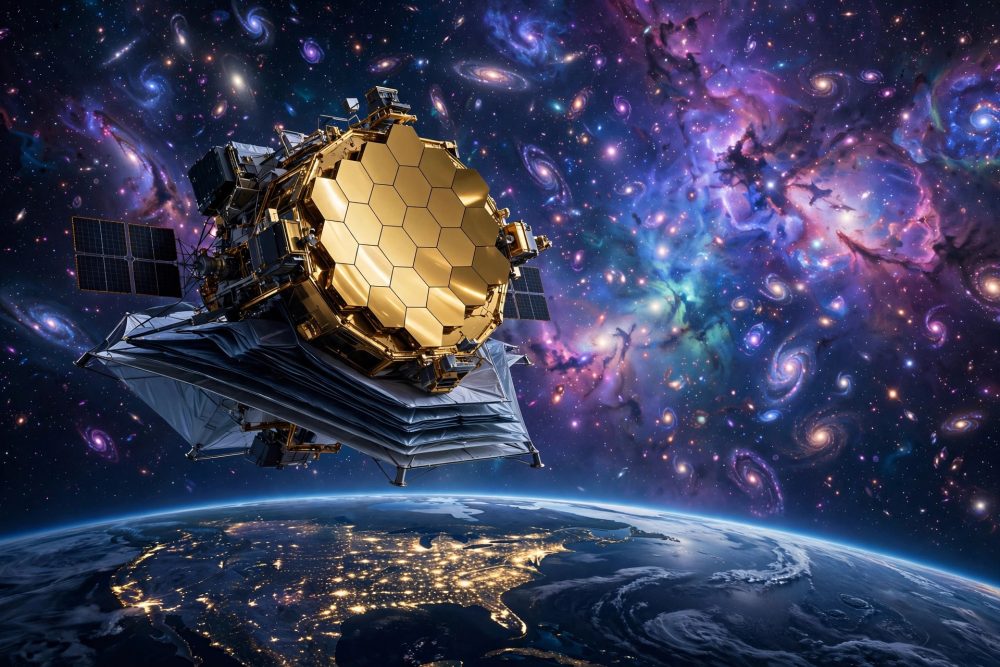
A Time Machine Made of Gold
On Christmas Day 2021, a rocket carried the most ambitious telescope ever built into space. The James Webb Space Telescope (JWST) unfolded itself like a giant golden flower a million and a half kilometres from Earth, and ever since, it has been showing us things no human eye has ever seen: galaxies as they were more than 13 billion years ago, only a few hundred million years after the Big Bang.
Webb is not just a better version of the Hubble telescope. It works in a fundamentally different way. While Hubble mostly captures visible light — the same light our eyes see — Webb is designed to capture infrared light: heat radiation with wavelengths too long for our eyes to detect. This one difference changes everything.
Why Infrared Sees Further Back in Time
The universe is expanding. This means the light from the most distant galaxies has been stretched during its long journey to us, shifting it from visible wavelengths into the infrared — a phenomenon called redshift. The further away a galaxy is, the older its light is, and the more stretched it becomes.
So the very oldest light in the universe, the light from the first galaxies, arrives at Earth as infrared radiation. Hubble, which sees mostly visible light, simply cannot see it. Webb's huge 6.5-metre gold-coated mirror and its ultra-sensitive infrared instruments were built precisely to catch this faint, ancient glow.
What Webb Has Found So Far
1. Galaxies far earlier than expected. Within its first year, Webb found surprisingly bright, well-formed galaxies existing just 300–400 million years after the Big Bang — much earlier than most theories predicted. Astronomers are still debating what this means: were early stars brighter than we thought, or did galaxies assemble faster than our models allow?
2. The atmospheres of distant worlds. Webb can analyse the light passing through the atmospheres of exoplanets — planets orbiting other stars. It has detected water vapour, carbon dioxide and methane on several worlds, and it is now searching for the chemical fingerprints that could one day hint at life.
3. Stars being born and dying. Its images of stellar nurseries — vast clouds of gas and dust where new stars are forming — and of dying stars shedding their outer layers are the most detailed ever taken, helping astronomers understand the life cycles of stars like our own Sun.
Why It Matters
Every image from Webb is, in a very real sense, a look into the past. Light takes time to travel: the light from the Sun left eight minutes ago, and the light from the most distant galaxies Webb studies left when the universe was barely 2% of its current age. By looking outward into space, Webb is looking backward into time.
For students and curious readers, the lesson is simple and powerful: science advances not only through new ideas but through new instruments. We could not see the first galaxies until we built a telescope that could see the right kind of light. The questions Webb is answering today will become the textbooks of tomorrow — and the questions it raises, like those impossibly early galaxies, will keep the next generation of scientists busy for decades.
The universe has been telling its story in infrared light for 13.8 billion years. Thanks to Webb, we have finally learned how to listen.


Comments 0
No comments yet. Be the first!
Leave a comment